


Purnululu National Park, Australia: A UNESCO World Heritage Site Preserving Unique Landscapes, Biodiversity, and Cultural Heritage
Purnululu National Park, a World Heritage Site in the remote East Kimberley region of Western Australia, stands as a profound testament to the monumental forces of geological time and a vibrant canvas of ancient biological and cultural heritage. Encompassing approximately 239,723 hectares of rugged wilderness, its heart and defining feature is the Bungle Bungle Range an astonishing assemblage of black and orange striped, beehive-shaped domes that rise dramatically from the surrounding savannah plains. This landscape, described by UNESCO as possessing “exceptional natural beauty” and “outstanding geological value,” remained largely unknown to the outside world until the 1980s, preserving an integrity that continues to captivate scientists, cultural custodians, and intrepid travelers alike. The park is not merely a collection of visually arresting rock formations; it is a complex, living system where the interplay of bedrock, climate, microscopic life, and deep human history has created a place of unparalleled significance. To understand Purnululu is to embark on a journey through hundreds of millions of years of Earth’s history, into a realm where the sandstone tells a story of ancient rivers and seas, where unique bands of color are painted by some of the planet’s oldest life forms, and where the cultural legacy of the Karjaganujaru and Gija peoples is woven into the very fabric of the land .
The Geological Genesis of a Phenomenon
The narrative of the Bungle Bungle Range begins in the Devonian period, around 360 million years ago, when the region was part of a vast river system or a shallow inland sea . Over eons, sediments of sand and gravel carried by these ancient waterways were deposited in extensive layers, gradually compressing under their own weight into a thick, robust formation of quartz sandstone and conglomerate. For hundreds of millions of years, this geological slab lay buried and undisturbed. The dramatic sculpting that created the iconic domes commenced a relatively recent twenty million years ago, initiated by the tectonic uplift of the entire Kimberley plateau. This uplift exposed the sandstone to the relentless sub-tropical climate, triggering one of the most spectacular and extensive displays of sandstone cone karst formation on the planet .
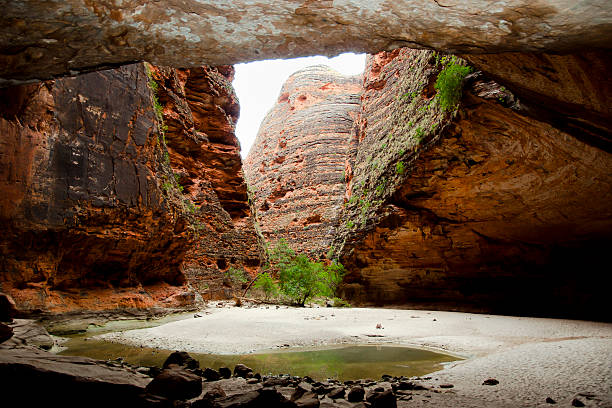
The formation of the characteristic beehive towers is a masterpiece of erosion, governed by a precise set of natural conditions. The sandstone, while hard, is shot through with natural joints and cracks. The region’s climate, characterized by a torrential monsoon wet season followed by an intensely hot dry season, acts as a powerful erosive engine . During the wet season, fierce rains cause flash flooding, which rapidly scours out the deep gorges and slot canyons that dissect the range, such as the magnificent Cathedral and Piccaninny Gorges. In the dry season, the exposed rock is subjected to immense temperature fluctuations, where the stone expands by day and contracts by night, gradually weakening its structure. Over millions of years, this cyclical weathering has rounded the edges of the jointed blocks, transforming them into the surreal, domed towers visitors see today. Importantly, this erosive process is ongoing; from the air, one can observe the active “weathering front” where new domes are being carved from the plateau’s edge, a slow-motion genesis that will continue for millions of years to come .
The Living Canvas: Cyanobacteria and the Signature Stripes
The most visually arresting feature of the Bungle Bungles the striking, regular bands of orange and dark grey or black that wrap around each dome is not a product of mineral variation alone, but of a remarkable biological partnership . These horizontal stripes are a direct result of differing porosity and moisture retention between the sandstone layers. The darker bands are composed of layers with a higher clay content, which holds moisture more effectively. This damp environment provides a habitat for colonies of cyanobacteria (once known as blue-green algae), which are among the oldest photosynthetic life forms on Earth .
These microscopic organisms form a thin, dark biological crust, or biocrust, on the rock’s surface. This living crust is a mere few millimeters thick but plays a role of heroic importance: it acts as a protective sheath, binding the sand grains together and shielding the softer sandstone beneath from rapid wind and water erosion . In stark contrast, the vibrant orange bands consist of sandstone layers that are more porous. They dry out too quickly after rain for the moisture-dependent cyanobacteria to colonize. Instead, exposed to the atmosphere, the iron minerals within the sandstone oxidize, or rust, producing the brilliant orange and red hues that glow spectacularly at sunrise and sunset. This interplay creates a living, breathing skin on the rock. The colors are dynamic, changing with the weather; after rain, the cyanobacterial bands darken to a deep, glossy black or green, while the orange bands become a richer, more saturated red .

A Sanctuary of Biodiversity in a Harsh Climate
Purnululu National Park exists in a climatic transition zone between the northern monsoon tropics and the southern arid deserts, fostering a surprising and significant diversity of life within its varied topography . The park’s ecosystems range from open spinifex and snappy gum woodlands on the sandy plains to secluded pockets of monsoon rainforest nestled in the deep, shaded gorges. These gorges, such as Echidna Chasm and those along Piccaninny Creek, function as critical refuges, preserving relic patches of vegetation and providing permanent water sources in the form of secluded pools that persist through the dry season. Here, majestic Livistona fan palms tower over clear creeks, creating oasis-like environments utterly distinct from the arid savannah above .
This habitat diversity supports a rich array of fauna. Biological surveys have recorded over 600 plant species, including 13 species of spinifex grass a greater diversity than anywhere else in Australia . The park is a haven for wildlife, with at least 149 bird species, including the rare Gouldian finch and the white-quilled rock-pigeon. Some 85 reptile species inhabit the park, among them the endemic Lerista bungle bungle, a small skink known only from the Cathedral Gorge area. Mammals, though often elusive, include several species of bats, short-eared rock wallabies, and the unique northern quoll. This biodiversity underscores the park’s role as a vital sanctuary, where rugged terrain and permanent water sources have allowed species to thrive at the edge of their ecological ranges .
Deep Time and Living Culture: The Aboriginal Heritage
Long before its geological wonders attracted global attention, Purnululu was a deeply spiritual and physical home. Aboriginal people, specifically the Karjaganujaru and Gija peoples, have maintained a continuous connection to this land for at least 20,000 years, and their cultural legacy is an inseparable part of the park’s World Heritage value . For these Traditional Owners, the landscape is not a passive setting but a creation of ancestral beings during the Ngarrangkarni (often translated as the Dreaming). Every rock formation, waterhole, and gorge is imbued with spiritual meaning, chronicled in song, ceremony, art, and story .
The people moved through this country in a seasonal cycle, utilizing its resources with profound knowledge and leaving behind a rich archaeological record. Hundreds of sacred sites are scattered throughout the park, including ancient rock art galleries, burial sites, and artifact scatters . In a powerful demonstration of the living nature of this culture, the dramatic beauty of the Bungle Bungle landscape directly inspired the internationally renowned Warmun (Turkey Creek) art movement. Artists from the region use natural ochres to create paintings that often represent aerial views of their country, mapping its stories and spiritual topography in a contemporary artistic form that draws directly from ancient tradition. Today, management of Purnululu National Park is a collaborative effort between the Western Australian Department of Biodiversity, Conservation and Attractions and the Traditional Owners, ensuring that cultural knowledge and obligations guide the protection of the land .
Visitor Experience and Practical Considerations
Experiencing the grandeur of Purnululu requires preparation, as its remote and rugged nature is integral to its preservation. The park is located roughly 300 kilometers south of the nearest service town, Kununurra, and access is strictly seasonal due to the monsoon . The park is open to visitors from approximately April 1 to December 31 each year, with the core dry season months of June to August being the most popular. The wet season (January to March) sees the park closed to ground access as roads become impassable and flooding is a serious risk .
There are two primary ways to visit. The most common approach is by four-wheel-drive vehicle via the Spring Creek Track, a rugged 53-kilometer journey from the Great Northern Highway that takes about three hours to navigate and is unsuitable for conventional vehicles or caravans . Within the park, a network of walking tracks allows exploration of key sites. These include the walk into the immense, cavernous Cathedral Gorge, with its permanent pool and incredible acoustics; the trek through the narrow, towering Echidna Chasm; and the more extended overnight hikes into the fingers of Piccaninny Gorge. The alternative, and arguably the most breathtaking way to appreciate the scale and pattern of the domes, is from the air. Scenic flights by light aircraft or helicopter operate from Kununurra, Warmun, and the park’s own Bellburn Airstrip, offering a perspective that truly reveals the maze-like complexity of the range .
Facilities within the park are deliberately limited to minimize impact. There are two designated campgrounds (at Walardi and Kurrajong) with basic amenities . A new visitor center, opened in 2023, provides essential information and educates guests on the park’s dual World Heritage values its unparalleled geology and its enduring Indigenous cultural heritage. Visitors must be entirely self-sufficient, carrying ample food, water, and fuel. The climate is extreme, with freezing temperatures possible on winter nights and daytime temperatures soaring above 40°C (104°F) in the late dry season, making sun protection and hydration critical .
Conservation and the Legacy of World Heritage
The inscription of Purnululu National Park on the UNESCO World Heritage List in 2003 under criteria (vii) for superlative natural beauty and (viii) for outstanding geological significance was a landmark event that formalized its global importance . This status has bolstered conservation efforts, extending protection beyond the original park boundaries. Adjacent reserves, including the Purnululu Conservation Park and the Ord River Regeneration Reserve, now form a substantial buffer zone, helping to safeguard the park’s watersheds and ecosystems from potential external pressures such as upstream land use changes .
The primary management challenges involve balancing increasing tourist interest with the imperative to protect the park’s fragile environment and sacred sites. The cyanobacterial crusts that protect the domes are incredibly delicate and can be damaged by foot traffic, necessitating strict adherence to marked walking tracks . The collaborative management model with Traditional Owners is crucial in this regard, integrating traditional fire management practices and cultural oversight to maintain the landscape’s health and spiritual integrity. Looking to the future, the park stands as a powerful symbol of wilderness conservation. It is a place that demands and rewards effort, offering not just a sight to see, but an experience that connects the visitor to the deep timescales of geology, the resilience of life, and the richness of the world’s oldest living cultures. In the silent, striped domes of the Bungle Bungles, one witnesses a story still being written, a testament to the enduring, dynamic beauty of the natural world.
Photo from iStock,Dreamstime.com

0 Comment to "Purnululu National Park, Australia: A UNESCO World Heritage Site Preserving Unique Landscapes, Biodiversity, and Cultural Heritage"
Post a Comment