


The University of Calcutta, established on January 24, 1857, stands as a monumental pillar in the history of South Asia. It was conceived not merely as an educational institution but as the first fully-fledged, modern university in the region, consciously modeled after the University of London. Its creation marked a definitive departure from millennia-old indigenous educational traditions and catalyzed the birth of a Western-style higher education system across the subcontinent. The founding of the university was a complex event, intertwined with the political ambitions of the British Empire and the intellectual ferment of the Bengali Renaissance, setting in motion profound social and intellectual changes that would ultimately shape modern India .
Historical Foundations and Context
The establishment of the University of Calcutta cannot be understood in isolation; it was the culmination of specific colonial policies and the evolving intellectual climate of 19th-century Bengal. For centuries, education in the Indian subcontinent had flourished through systems like the gurukuls and renowned centers of advanced learning such as Takshashila and Nalanda, which attracted scholars from across Asia . However, by the early 1800s, a new intellectual movement the Bengal Renaissance was taking root. Spearheaded by reformers like Raja Ram Mohan Roy, this movement championed a synthesis of Western rationalism and modern sciences with Indian traditions . This created a growing demand for Western education among the Bengali elite.
The decisive political push came from London in the form of Wood's Despatch of 1854, a comprehensive education policy authored by Sir Charles Wood, President of the Board of Control of the East India Company . Often called the "Magna Carta of Indian Education," this document explicitly recommended establishing universities in the three Presidencies of Calcutta, Bombay, and Madras. Wood's motivations were strategic. In a revealing letter to Lord Dalhousie, he expressed a desire to create a class of English-educated Indians to serve the colonial administration, while being cautious about "providing our own future detractors, opponents and grumblers". The despatch outlined a blueprint for a university based on the University of London, functioning primarily as an examining and degree-granting body for affiliated colleges .
Following this directive, the Calcutta University Act (Act II of 1857) was passed by the Legislative Council and received the assent of Governor-General Lord Canning on January 24, 1857 . The Act created a "Body Politic and Corporate" known as the University of Calcutta, with a 41-member Senate as its supreme governing body. Lord Canning himself became the first Chancellor, and Sir James William Colvile, the Chief Justice of the Supreme Court, was appointed the first Vice-Chancellor. The university's initial territorial jurisdiction was staggering, extending from Kabul in the northwest to Rangoon (Yangon) in the east and Ceylon (Sri Lanka) in the south essentially covering most of British India . This vast catchment area underscored its intended role as the subcontinent's premier institution of higher learning.
Evolution from an Examining Body to an Intellectual Powerhouse
In its earliest incarnation, the University of Calcutta functioned strictly as an affiliating and examining university . It did not conduct teaching itself but set curricula, held examinations, and conferred degrees for its constituent colleges. These founding colleges included prestigious institutions like Presidency College (originally Hindu College), the Sanskrit College, the Calcutta Medical College (India's first medical school), and the Bengal Engineering College. The university's administrative beginnings were modest; its first Senate meeting was held at the Calcutta Medical College, and its offices operated from rented rooms on Camac Street, with significant administrative work conducted from the Writers' Buildings and the Kolkata Town Hall .
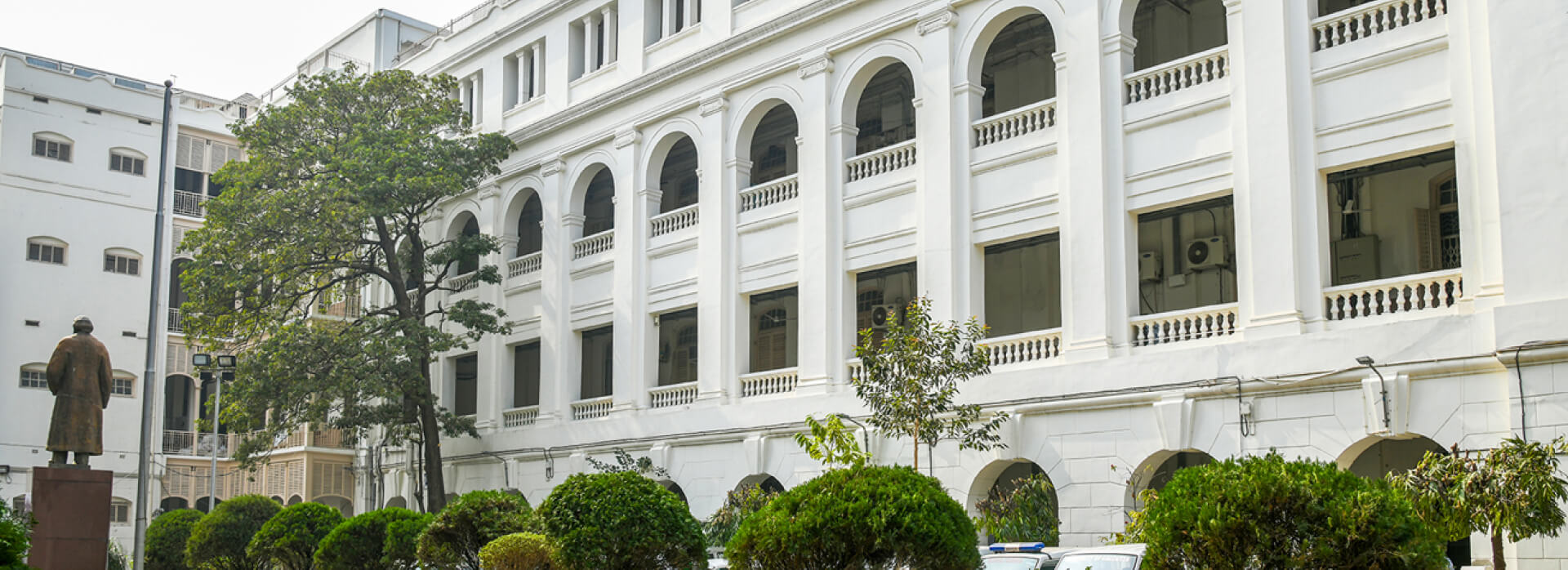
A pivotal moment in the university's physical and symbolic growth was the construction of the Senate House. Designed by the renowned Victorian architect Walter B. Granville and inaugurated on March 12, 1873, this grand building on College Street became the university's iconic headquarters and a landmark in the "City of Palaces" . It housed meeting halls, the Vice-Chancellor's chamber, and examination rooms, finally providing the growing institution with a dignified home .
The turn of the 20th century marked the university's transformation into a full-fledged teaching and research institution. This shift was largely driven by the visionary leadership of Sir Asutosh Mukherjee, who served as Vice-Chancellor from 1906 to 1914 and again in 1921-23 . During his tenure, he oversaw the establishment of postgraduate teaching departments, the founding of the University College of Science in 1914, and the creation of numerous endowed professorships. This era also saw extraordinary philanthropic support from Indian benefactors, breaking the initial British aristocratic mold of the institution. Notably, lawyers Taraknath Palit and Rash Behari Ghosh donated generously to found the University College of Science, while the Maharaja of Darbhanga funded the construction of the Darbhanga Building. As early as 1866, Vice-Chancellor Henry Sumner Maine observed this democratizing trend, noting that the founders "thought to create an aristocratic institution; and, in spite of themselves, they have created a popular institution" .
Pioneering Social Reforms and Academic Excellence
The University of Calcutta was a trailblazer in social reform, most notably in the realm of women's education. In a groundbreaking achievement for South Asia, Kadambini Ganguly and Chandramukhi Basu graduated with Bachelor of Arts degrees in 1883, becoming the first female graduates of the university and the region . Ganguly went on to become the first female doctor in South Asia to practice Western medicine. Their alma mater, Bethune College the first college for women in India—was affiliated with the university, cementing its role in shattering gender barriers in higher education .
The institution's commitment to meritocracy and intellectual freedom fostered an environment that produced an unparalleled constellation of scholars and leaders. Its alumni and faculty include a remarkable roster of Nobel laureates: Rabindranath Tagore (Literature, 1913), C.V. Raman (Physics, 1930), Amartya Sen (Economics, 1998), and Abhijit Banerjee (Economics, 2019) . Furthermore, it was intimately connected with the Indian independence movement. Figures like Subhas Chandra Bose (though expelled from Presidency College for revolutionary activities), Swami Vivekananda, and India's first President, Dr. Rajendra Prasad, were all shaped by their association with the university. The faculty roster was equally distinguished, including scientists like Jagadish Chandra Bose and philosophers like Sarvepalli Radhakrishnan .
Post-Independence Legacy and Continued Eminence
Following India's independence in 1947, the University of Calcutta underwent significant restructuring. The Calcutta University Act of 1951 replaced the colonial-era acts, democratizing its governance structure . Its once-continental jurisdiction was gradually reduced to districts of West Bengal as new universities were established across the nation. By the mid-1970s, it had evolved into one of the largest universities in the world, with over 150 affiliated colleges and 16 postgraduate faculties. The historic Senate House was demolished after the university's centenary in 1957 to make way for the more utilitarian Centenary Building, which now houses the central library and administrative offices.
Today, the university continues to be a beacon of higher education. It is accredited with the highest "A" grade by India's National Assessment and Accreditation Council (NAAC) and consistently ranks among the nation's top universities . It operates across 14 campuses in Kolkata and its suburbs, maintaining a vast network of affiliated colleges. Its central library and departmental libraries hold over a million books and journals, serving as a vital resource for scholars .
The founding of the University of Calcutta in 1857 was a watershed event that laid the cornerstone of modern higher education in South Asia. Born from a colonial policy aimed at creating a compliant bureaucracy, it was swiftly embraced and transformed by Indian intellect, philanthropy, and leadership into a powerful engine of social change, scientific discovery, and national awakening. From granting the first degrees to women in the region to housing Nobel Prize-winning research, its history is a microcosm of India's journey from colonialism to modernity. It stands not merely as an "old" university, but as a living institution whose foundational legacy continues to advance learning and shape the minds that define the future.

0 Comment to "The University of Calcutta: How the First Modern University in South Asia Was Founded in 1857"
Post a Comment