


International Human Solidarity Day, observed each year on December 20, stands as one of the United Nations’ most profound annual observances. Unlike commemorations tied to historical events or specific groups, this day is dedicated to a fundamental principle that underpins the very mission of the UN and the future of our shared world: the idea that our collective fate as a human family is inextricably linked, and that our most daunting challenges can only be met through mutual support and cooperation. In a global landscape often marked by division, inequality, and conflict, this day serves as a vital reminder and a call to action. It reaffirms a simple but powerful truth that is woven through the United Nations Charter our shared future depends on how well we act together. The day is not merely a symbolic gesture; it is an active framework for translating the abstract ideal of solidarity into practical policy, humanitarian response, and individual responsibility. It invites everyone governments, civil society, the private sector, and individuals to move from commitment to concrete action, particularly in the monumental task of achieving the Sustainable Development Goals and eradicating poverty .
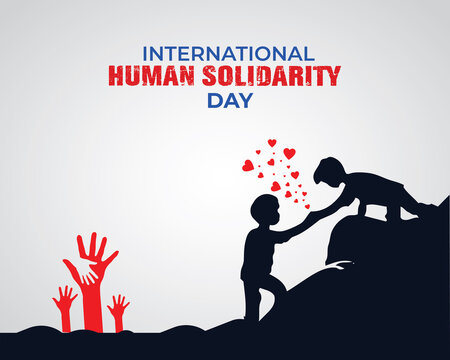
The genesis of International Human Solidarity Day is deeply rooted in the philosophical and operational evolution of the United Nations at the dawn of the 21st century. The formal proclamation came on December 22, 2005, when the UN General Assembly, through resolution 60/209, officially declared December 20 as International Human Solidarity Day . This declaration, however, was the culmination of several years of foundational work. The intellectual and moral bedrock was laid in the year 2000 with the adoption of the UN Millennium Declaration. In this landmark document, world leaders identified solidarity as one of the fundamental and universal values essential for international relations in the new century, placing it alongside freedom, equality, and tolerance. To give practical force to this value, the General Assembly established the World Solidarity Fund in 2002 (resolution 57/265) as a specific trust fund aimed at eradicating poverty and promoting human development in the world's poorest nations. The choice of December 20 for the annual observance directly commemorates the creation of this fund. Therefore, the day represents a seamless fusion of high principle and pragmatic mechanism, born from the recognition that in an era of globalization, strengthening international solidarity is not optional but indispensable for survival and progress .
The core purposes of International Human Solidarity Day, as articulated by the United Nations, are multi-faceted and action-oriented. It is designed to be several things simultaneously: a celebration of our unity in diversity; a reminder to governments to respect their commitments to international agreements; a global moment to raise public awareness of solidarity's critical importance; a platform to encourage debate on innovative ways to promote solidarity for achieving the Sustainable Development Goals; and, most importantly, a day of action to spur new initiatives for poverty eradication . This combination of celebration, advocacy, and mobilization distinguishes it from passive observances. The day is intrinsically linked to the 2030 Agenda for Sustainable Development, an agenda centred on people and the planet, underpinned by human rights, and supported by a global partnership determined to lift humanity out of poverty, hunger, and disease. The agenda itself, therefore, is built on a foundation of global cooperation and solidarity . By focusing on this link, the day moves the conversation beyond charity to one of shared responsibility and systemic change, emphasizing that sustainable development is impossible without a genuine commitment to standing together.
To understand solidarity in action, one must look at its operationalization across the United Nations system, where abstract values translate into life-saving assistance and structural support. The UN demonstrates that solidarity becomes real when it is organized through cooperation, predictable support, and shared responsibility . A prime example is the work coordinated by the UN Office for the Coordination of Humanitarian Affairs (OCHA) through the Central Emergency Response Fund (CERF). This fund is a practical embodiment of global solidarity, allowing for the rapid and flexible delivery of life-saving assistance when sudden crises strike and in chronically overlooked emergencies. Similarly, the UN Refugee Agency (UNHCR) operationalizes solidarity through the Global Compact on Refugees, a framework designed to ensure more predictable and equitable sharing of responsibility for hosting and supporting refugees, recognizing that sustainable solutions are impossible without international cooperation. For the UN Children's Fund (UNICEF), solidarity is reflected in the voluntary contributions from the global community that fund essential services for children in crises and fragile settings. Furthermore, the Office of the UN High Commissioner for Human Rights (OHCHR) champions solidarity by protecting the civic space that allows people and civil society to act peacefully in pursuit of justice and equality . These mechanisms show that solidarity is not a vague sentiment but a structured, funded, and essential component of the international community's toolkit for peace, development, and human dignity.
The observance of International Human Solidarity Day is given further focus and direction through annual themes, which connect the timeless principle to contemporary global challenges. These themes provide a lens through which governments, organizations, and individuals can orient their discussions and activities. For instance, recent themes have included "Together: Respect, Safety, and Dignity for All" in 2020, emphasizing the protection of fundamental human rights for every person . The theme "Our Future Rests on Solidarity," used in both 2022 and 2024, powerfully communicates the idea that overcoming global challenges is contingent upon collective action. For 2025, the designated theme is "Solidarity for Sustainable Development: Uniting Communities for a Shared Future," which explicitly ties the concept to the urgent timeline of the Sustainable Development Goals and the need for cross-border community empowerment . These evolving themes ensure the day remains a dynamic and relevant part of the global dialogue, adapting to the pressing issues of the moment while steadfastly anchoring them in the principle of shared responsibility.
The philosophical and spiritual dimensions of human solidarity find powerful resonance in the world's great religious and ethical traditions, which enrich the secular framework provided by the UN. The teachings of Islam, for example, offer a profound foundation for the principle of solidarity. The Holy Qur’an emphasizes the shared origin of all humanity: "O humankind! Indeed, We created you from a male and a female and made you into nations and tribes so that you may know one another" (49:13) . It further exhorts believers to "cooperate with one another in goodness and righteousness" (5:2). The sayings of the Prophet Muhammad and the Ahl al-Bayt reinforce this with striking metaphors and direct commands. One well-known teaching states, "The believers, in their mutual affection, mercy, and compassion, are like a single body: when one limb suffers, the rest of the body responds with wakefulness and fever". Another asserts that a person who does not care for the affairs of other Muslims is not one of them, framing social responsibility as an inseparable component of faith . This spiritual perspective complements the UN's mission by rooting the call for solidarity in a deep sense of moral duty and universal brotherhood, demonstrating that the drive for a more cohesive world is a shared aspiration across civilizations.
For the individual wondering how to contribute, International Human Solidarity Day offers a wide spectrum of meaningful avenues for engagement, from local community action to global advocacy. The UN and other organizations encourage proactive participation that moves beyond passive awareness. On a personal level, individuals can educate themselves and others about the Sustainable Development Goals and the critical role of partnerships in achieving them . Volunteering, particularly through platforms like the UN Volunteers Online service, allows people to donate their skills remotely to support UN entities and their partners anywhere in the world. Contributing to humanitarian funds like the Central Emergency Response Fund (CERF) is a direct way to support rapid, life-saving aid in underfunded emergencies. At a community level, people can support or initiate local projects that address pressing needs like homelessness, education gaps, or health disparities, thereby practicing solidarity in their immediate environment. Organizing or participating in educational events, workshops, and cultural exchanges fosters mutual understanding and highlights the importance of collective problem-solving. In the digital realm, individuals can use social media campaigns to share stories of unity, promote accurate information during crises, and advocate for inclusive policies, using hashtags like #SolidarityDay and #GlobalGoals to join the global conversation . These actions, whether large or small, form the essential fabric of a global culture of solidarity.
International Human Solidarity Day is far more than a date on the UN calendar. It is an annual reaffirmation of a foundational truth for our century: that in the face of pervasive challenges from poverty and inequality to climate change and conflict, humanity's best and only hope lies in conscious, organized, and principled unity. It bridges the gap between the lofty ideals enshrined in the Millennium Declaration and the on-the-ground realities faced by the vulnerable, connecting the diplomatic halls of the UN with community projects and individual acts of compassion. The day celebrates the rich diversity of the human family while insisting on our profound interdependence, a concept echoed from the scriptures of world religions to the resolutions of the General Assembly. By reminding governments of their pledges, empowering civil society, and providing a platform for action, International Human Solidarity Day transforms the abstract value of solidarity into a tangible force for change. It asserts that building a world of peace, dignity, and opportunity for all is a shared project one that requires the persistent commitment of every nation, every community, and every individual. As we observe this day, we are invited not just to reflect but to act, recognizing that our collective future truly does rest on the choices we make to stand together.
Photo from : Adobe Stock

0 Comment to "International Human Solidarity Day: A Global Pledge for Unity, Cooperation, and Collective Action Towards a Sustainable and Equitable Future"
Post a Comment