


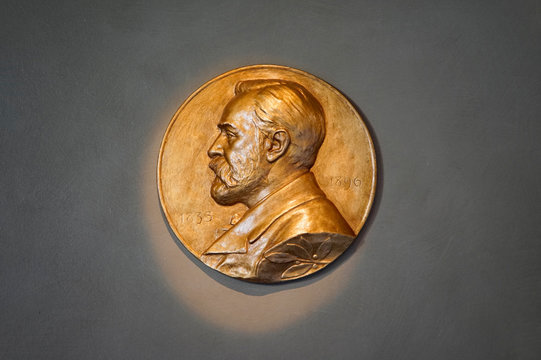
The Nobel Prizes, first awarded in 1901, were born from a final act of redemption. Swedish chemist and armaments manufacturer Alfred Nobel, inventor of dynamite, was shaken by a premature obituary that labeled him a "merchant of death". Determined to leave a different legacy, he signed a will in 1895 dedicating his immense fortune to establishing annual prizes for those who had "conferred the greatest benefit on mankind" in physics, chemistry, medicine, literature, and peace. His death on December 10, 1896, set in motion a complex five-year journey of legal battles and international negotiations to realize his vision. On that same date in 1901, five years after his passing, the first awards were finally presented . In its first decade, the Nobel Prize established its enduring traditions and witnessed several historic milestones, including the controversial award to a warrior-president and the groundbreaking recognition of a pioneering female writer, reflecting both the promise and the complexities of Alfred Nobel's ambitious vision.
The Genesis of a Legacy: Alfred Nobel's Will and Vision
Alfred Nobel's last will was a brief, astonishing document that bypassed his family to dedicate nearly his entire fortune 31 million Swedish kronor, a colossal sum to creating the prizes . He specified the five fields and, crucially, decreed that the Peace Prize would be awarded by a committee of five persons elected by the Norwegian Parliament. This particular stipulation was strategic, as Norway was in a union with Sweden at the time and Nobel believed its parliament would be a more neutral body for judging peace efforts. However, the will's execution was fraught with difficulty. The Nobel family contested it, French authorities sought to levy heavy taxes on his French assets, and the Swedish royal court was initially skeptical. It was not until 1900, after protracted negotiations, that the Nobel Foundation was formally established to manage the funds and coordinate the prize-awarding institutions: the Royal Swedish Academy of Sciences (Physics and Chemistry), the Karolinska Institute (Medicine), the Swedish Academy (Literature), and the Norwegian Nobel Committee (Peace). This foundation ensured the financial and administrative stability needed to launch the inaugural awards in 1901, on the fifth anniversary of Nobel's death .
The Historic First Ceremony: Stockholm, December 10, 1901
The atmosphere in Stockholm on December 10, 1901, was one of hushed anticipation. Unlike today, the laureates' names were a closely guarded secret until the moment they received their awards . The ceremony was held in the grand hall of the former Royal Swedish Academy of Music, specially decorated for the occasion with pine boughs and a central bust of Alfred Nobel beneath a giant laurel wreath. The audience, comprising Sweden's intellectual and official elite, watched as the first laureates took their seats: Wilhelm Conrad Röntgen (Physics) for his discovery of X-rays; Jacobus Henricus van 't Hoff (Chemistry) for laws of chemical dynamics; Emil Adolf von Behring (Medicine) for a diphtheria antitoxin; and the French poet Sully Prudhomme (Literature), who was ill and represented by his country's minister. The awards were presented by Crown Prince Gustaf (the future King Gustaf V), standing in for his father who was in Norway during political tensions in the Swedish-Norwegian union. The presentations were somewhat unorthodox by modern standards; for instance, the scientific prizes were described by the Chairman of the Academy of Sciences, who openly admitted the subjects were "certainly foreign to him". The ceremony concluded with a men's choir singing a student song and a musical march .
Immediately following, the first Nobel Banquet was held at the city's Grand Hotel for 113 male guests . The five-course menu, costing about 15 kronor per person, featured dishes like poached brill and fillet of beef imperial, setting a precedent for culinary excellence. The evening was marked by toasts and celebration, with student marshals reportedly carrying the diminutive chemist van 't Hoff around the room in a gold chair in the early hours. Reaction to the prizes was not universally celebratory, however. A faction of Sweden's literary elite, including the playwright August Strindberg, was outraged that the Literature Prize went to Sully Prudhomme over their preferred candidate, Leo Tolstoy, and even contemplated sending a formal protest. This immediate controversy underscored the challenge Nobel committees would perpetually face: the near-impossibility of selecting laureates who would win approval "in all quarters and among all literary tastes".
In Oslo (then called Christiania), the first Nobel Peace Prize was awarded separately on the same day. It was jointly presented to Jean Henry Dunant of Switzerland, founder of the International Red Cross, and French peace activist Frédéric Passy, fulfilling Nobel's directive to honor work for "fraternity between nations" and the reduction of standing armies .
A Warrior for Peace: Theodore Roosevelt's 1906 Prize
The 1906 Nobel Peace Prize awarded to U.S. President Theodore Roosevelt was a decision that sparked immediate and profound controversy, encapsulating the inherent tensions in judging "peace" in a complex world. Roosevelt was honored specifically for his pivotal role in brokering the Treaty of Portsmouth, which ended the bloody Russo-Japanese War in 1905 . The conflict had exhausted both powers, and Japan, despite military successes, sought mediation to secure its gains. Roosevelt, whose nation was emerging as a global power, skillfully facilitated negotiations. He first hosted diplomats at his Sagamore Hill home, then oversaw talks at the Portsmouth Naval Shipyard, deftly navigating the deadlock over war indemnities. His successful mediation earned him international acclaim and the Nobel Committee's recognition for ending a war between two great powers .
However, the award was fiercely criticized. Roosevelt was a celebrated imperialist and military adventurer. He had championed the Spanish-American War, led the "Rough Riders" cavalry in Cuba, and oversaw the violent U.S. campaign in the Philippines . Domestically, the New York Times had once labeled him "the most warlike citizen of these United States". Swedish newspapers caustically remarked that Alfred Nobel must be "turning over in his grave". Critics alleged the Norwegian committee selected Roosevelt to curry favor with the United States, hoping to gain a powerful ally as Norway moved toward independence from Sweden.
Roosevelt himself articulated a nuanced, muscular philosophy of peace in his delayed Nobel lecture, delivered in Oslo in 1910. He argued that "peace is generally good in itself, but it is never the highest good unless it comes as the handmaid of righteousness" . For him, a just and prepared peace, backed by strength, was superior to a weak peace born of cowardice. This rationale, which framed his mediation as an act of prudent statecraft to balance power in Asia, did not silence detractors but solidified the award as one of the most debated in Nobel history . It established a precedent that the Peace Prize could recognize specific diplomatic achievements even of leaders with otherwise conflict-ridden records.
Breaking the Mold: Selma Lagerlöf and the 1909 Literature Prize
In stark contrast to the geopolitical drama of Roosevelt's prize, the 1909 Nobel Prize in Literature was a landmark for cultural and gender equality. It was awarded to Swedish author Selma Lagerlöf "in appreciation of the lofty idealism, vivid imagination and spiritual perception that characterize her writings" . This decision was revolutionary on two counts: Lagerlöf became the first woman and the first Swedish writer to receive the Nobel Prize in any field .
Lagerlöf's selection was the culmination of years of deliberation and shifting literary tastes. Her work, beginning with the 1891 novel Gösta Berling's Saga, represented a decisive break from the prevailing realism of the era . Rooted in the folk tales and legends of her native Värmland, her stories were infused with mythic qualities, vivid imagination, and deep moral perception. This style was not initially embraced by the old guard of the Swedish Academy, particularly its powerful permanent secretary, Carl David af Wirsén, who had long opposed her candidacy in favor of more traditional figures like English poet Algernon Charles Swinburne. However, by 1909, a new generation of Academy members and a strong wave of nominations from Scandinavian professors prevailed . The majority recognized that Lagerlöf's unique voice had elevated Swedish literature and narrative art to new heights.
The award was met with great enthusiasm in many quarters. The French newspaper Le Figaro praised "the mark of her noble soul" evident in all her work, from her adult novels to the beloved children's book The Wonderful Adventures of Nils . Her acceptance speech itself was a masterpiece of storytelling. Rather than delivering a conventional lecture, Lagerlöf recounted a fantastical tale of visiting her father in heaven to seek help repaying a "debt" the debt she owed to all the friends, family, and even characters from stories who had supported her journey . The speech was a poignant and personal performance that perfectly embodied the imaginative spirit for which she was honored. Her victory paved the way for future female laureates and validated storytelling that drew power from local folklore and universal human ideals.
The Evolution of Tradition and Lasting Impact
These early ceremonies established core traditions that have endured and evolved. By 1926, the Stockholm ceremony moved permanently to its current home, the Stockholm Concert Hall . The banquet outgrew the Grand Hotel's Hall of Mirrors and, since 1930, has been held in the magnificent Blue Hall of Stockholm City Hall, now hosting about 1,300 guests. The Oslo ceremony found a permanent home at the Oslo City Hall in 1990. The rituals solidified: the presentation of the diploma and medal by the monarch, the laureate's lecture, and the meticulously planned banquet with its secret menu and flowers from San Remo where Nobel died became integral parts of "Nobel Week".
The pioneering awards from 1901 to 1909 set a powerful trajectory for the century to come. They demonstrated that the Nobel Prize could simultaneously honor foundational scientific discovery (Röntgen's X-rays), life-saving medicine (von Behring's serum), transcendent artistry (Lagerlöf's literature), and arduous diplomatic peacemaking (Roosevelt's mediation). They also revealed the institution's inevitable growing pains: the difficulty of judging literary merit, the political dimensions of the Peace Prize, and the challenge of maintaining a committee's impartiality against a backdrop of public opinion and national interest. From the quiet solemnity of the first ceremony to the global headlines generated by Roosevelt's award and Lagerlöf's breakthrough, these early years transformed Alfred Nobel's personal act of legacy-building into the world's most prestigious accolade, an annual ritual that continues to reflect humanity's highest aspirations and most complex contradictions.
Photo from: Adobe Stock
0 Comment to "The Inaugural Nobel Prizes in 1901 and the Historic First Awards to an American President and a Female Author in 1906 and 1909"
Post a Comment