


In August 1684, a young astronomer named Edmond Halley made an impromptu visit to Cambridge to consult the university's reclusive mathematics professor, Isaac Newton, on a question that was vexing London's brightest scientific minds: what path a planet would follow if it were attracted to the Sun by a force that diminished with the square of its distance. Newton's immediate reply "an ellipse" and the subsequent manuscript he produced, De motu corporum in gyrum ("On the motion of bodies in an orbit"), ignited a chain of events that culminated in a revolution in human thought. The reading of this paper to the Royal Society on 10 December 1684 stands as a pivotal moment in the history of science, marking the first public demonstration that the celestial mechanics of Johannes Kepler could be derived from, and unified by, a single, universal physical principle.
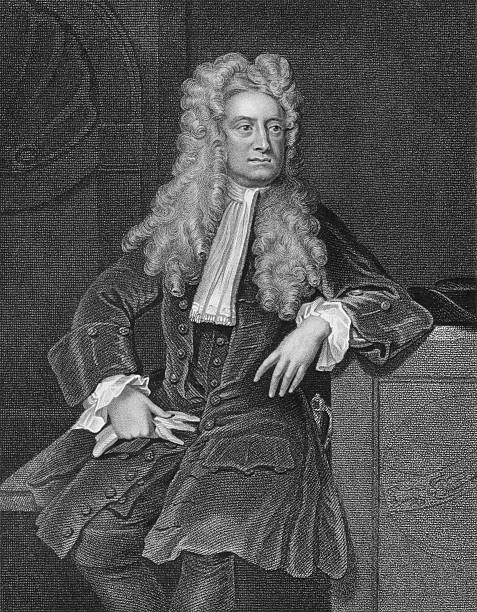
The Intellectual Crucible: A Problem of Planetary Motion
The journey to this December presentation began months earlier with a dinner conversation among three prominent members of the Royal Society: Halley, the architect Sir Christopher Wren, and the brilliant but contentious polymath Robert Hooke . The trio was debating the physical cause of planetary orbits. Many, including Hooke, suspected that the force holding planets to the Sun obeyed an inverse-square law that is, it weakened in proportion to the square of the distance from the Sun. However, suspicion was not proof. The critical question, the one Wren posed as a challenge, was a converse one: if such a force existed, what would be the precise geometric shape of the resulting orbit? Hooke claimed to have a solution but would not produce it. Wren, unconvinced, offered a prize of a book worth 40 shillings to anyone who could furnish a convincing demonstration within two months. The prize went unclaimed .
Halley, preoccupied by a series of family tragedies, could not let the problem go . Later that summer, he resolved to seek out Newton, a man whose mathematical genius was already whispered about in scientific circles, though he had published little. Their meeting was brief but momentous. When Halley posed the question, Newton, without hesitation, stated that the path would be an ellipse. An astonished Halley asked how he knew. "Why," said Newton, "I have calculated it". When pressed for the calculation, Newton could not find his old papers but promised to rework the proof and send it to Halley. True to his word, by November 1684, a short manuscript titled De motu corporum in gyrum was in Halley's hands. Recognising its profound significance, Halley presented its contents to the Royal Society on 10 December 1684, formally introducing Newton's groundbreaking synthesis to the world .
The Architecture of a Revolution: Dissecting De Motu
De motu was a dense, nine-page manuscript comprising definitions, hypotheses, theorems, and problems, all written in the rigorous geometric language of the time . Far from a mere answer to the ellipse question, it laid the foundational framework for what would become Newtonian dynamics. The manuscript begins by establishing its conceptual vocabulary. Newton introduced the term "centripetal force" for the first time, defining it as a force that "impels or attracts a body to some point regarded as a center" . This was a crucial conceptual step, giving a name to the action that constantly deflects a body from straight-line inertial motion into a curved path. He also defined "inherent force" (akin to inertia) and set out preliminary hypotheses that would later mature into his famous laws of motion. For instance, his second hypothesis states that by its intrinsic force alone, a body would move uniformly in a straight line forever a clear precursor to the First Law of Motion .
The core of the manuscript then proceeds through a series of logical propositions, using geometric limit arguments that were, in essence, his calculus in geometric disguise . The first and most profound of these is Theorem 1, which demonstrates that a body subject to any central force will sweep out equal areas in equal times. Newton's proof was a masterpiece of geometric reasoning. He imagined a body moving under brief, impulsive tugs of force directed toward a central point. By analysing the triangular areas formed by the radius vector (the line from the center to the body) over equal time intervals, he showed they were all equal. By then letting the number of impulses increase infinitely, he proved the principle holds for a continuously acting force. This was a direct mathematical derivation of Kepler's Second Law, but with a critical expansion: Newton showed the law was not unique to planets or ellipses, but a universal property of all motion under any central force . Having established this general principle, Newton then tackled the specific relationship between force and orbit shape. In a series of problems, he worked "inversely": starting from an assumed orbital shape, he derived the force law required to produce it .
For motion in a circle with the force center at the circle's center, he found the force must be directly proportional to the radius (a spring-like force).
For motion in an ellipse with the force center at the ellipse's geometric center, the force must also be proportional to the distance.
The climactic moment came in Problem 3. Here, Newton considered an elliptical orbit with the center of attraction at one focus of the ellipse . His geometric analysis yielded a stunningly simple result: the centripetal force must be "in the doubled ratio of the distance" that is, inversely proportional to the square of the distance from the focus. He had demonstrated mathematically that an inverse-square centripetal force is both necessary and sufficient for elliptical orbits with the Sun at a focus. In a scholium (explanatory note) following this proof, Newton explicitly connected his abstract mathematics to the cosmos: "The major planets orbit, therefore, in ellipses having a focus at the center of the Sun, and with their radii... describe areas proportional to the times, altogether as Kepler supposed" . In a handful of pages, he had derived Kepler's First and Second Laws from a dynamic principle.
The manuscript went further still. Newton noted that if the orbital speed were high enough, the inverse-square law could also produce open conic sections: parabolas or hyperbolas . This was the first theoretical explanation for the paths of comets, a problem that would later become Halley's own obsession. Finally, in the corollaries to his theorems, Newton showed that for circular orbits, an inverse-square force law logically leads to Kepler's Third Law that the square of the orbital period is proportional to the cube of the orbital radius . From a single force law, all three of Kepler's planetary rules emerged as inevitable consequences.
From Manuscript to Monument: Halley's Crusade and the Birth of the Principia
Halley's role did not end with presenting the paper. He immediately grasped that De motu was not a finished product but a breathtaking prospectus for an entirely new system of the world . With a diplomat's tact and a patron's dedication, he embarked on a campaign to coax the reclusive, sensitive, and often irascible Newton into expanding this brief tract into a comprehensive work .This was no small task. Newton, secretive and averse to controversy, was a difficult figure . Halley's mission became one of relentless encouragement, practical management, and crisis diplomacy. When the Royal Society, financially strained from publishing another lavish book, initially agreed to print Newton's work but then reneged, it was Halley who personally undertook the financial risk to fund the publication himself. When Robert Hooke infuriated Newton by claiming priority for the inverse-square idea, threatening to derail the entire project as Newton threatened to suppress the crucial third book, it was Halley who intervened with careful, pacifying letters, assuring Newton of his preeminence and pleading for the work's completion. Halley edited the text, managed the printers, and even wrote a promotional ode for its preface .
The fruit of this extraordinary collaboration was published in July 1687: Philosophiæ Naturalis Principia Mathematica (Mathematical Principles of Natural Philosophy) . The Principia is De motu magnified to a cosmic scale. Its three books systematically build the edifice of classical mechanics, with the core arguments of the 1684 manuscript—the laws of motion, the area law, and the solution to the "Kepler Problem" forming the vital heart of Book I. In its pages, Newton completed the unification hinted at in De motu. He proposed and defended his law of universal gravitation: every particle of matter in the universe attracts every other particle with a force proportional to the product of their masses and inversely proportional to the square of the distance between them. He demonstrated that this same force explained not only planetary ellipses but also the orbits of moons, the trajectory of projectiles, the tides of the ocean, and the very fact that objects fall to Earth. The falling apple and the orbiting Moon were shown to be manifestations of the same cosmic principle.
A Legacy of Unification: The Meaning of 10 December 1684
The reading of De motu on 10 December 1684 was the spark that lit the fuse. Its historical significance is multifaceted and profound. Scientifically, it marked the definitive shift from Kepler's descriptive, kinematic "laws" to Newton's explanatory, dynamic "theory." Kepler had described how the planets moved; Newton explained why they had to move that way, deriving celestial kinematics from a fundamental physical cause . This act of unification was its greatest triumph. It proved that the same mechanical principles governing events on Earth operated without modification in the heavens, dismantling the ancient Aristotelian dichotomy between the sublunar and celestial realms . The universe was now a coherent, law-bound system.
The event also highlights the indispensable, often understated, role of community and patronage in science. Without Halley's insightful question, his persistent encouragement, his financial backing, and his diplomatic skill in navigating the fraught personalities of the Royal Society, it is entirely possible that Newton's genius might have remained locked away in Cambridge . Halley was the midwife to one of history's greatest intellectual achievements.
Finally, the ideas contained in that brief manuscript reshaped the modern worldview. By providing a mathematical framework that could predict the motion of bodies from cannonballs to comets, Newtonian mechanics became the bedrock of the Enlightenment, embodying a new faith in order, reason, and the intelligibility of nature . The universe was no longer a mystery guided by occult sympathies or divine whim; it was a grand machine whose workings could be discovered, written down, and understood. While later physics, from Einstein's relativity to quantum mechanics, would show the limits of Newton's framework, its power and scope remain the foundation of engineering and spaceflight. It all began with a question, an answer, and a nine-page manuscript whose contents, presented on a winter's day in 1684, changed our understanding of the cosmos forever.
0 Comment to "The Decisive Presentation: How Halley's 1684 Royal Society Lecture on Newton's De Motu Revolutionized Celestial Mechanics"
Post a Comment